Behind the Object Tags: Museum as a Learning Space
— A Conversation with Qingyi (Emmy) Sun (PhD student in East Asian and Comparative Literatures)
Interviewer: Cynthia Chen (PhD student in East Asian and Comparative Literatures)
Date: Dec 5, 2024
Can you briefly introduce the trip to us?
In November 2024, the class went on a three-day visit to Kansas City. The Nelson-Atkins Museum of Art has the best Chinese furniture gallery in North America and is a great location for comparative studies of beds from around the world and across time. During the visit, the graduate students also had a chance to practice their lecturing skills by delivering mini-lectures through engaging with exhibition objects.
Did you do any preparation for this pedagogical training before the trip?
Yes, I worked with Professor Ma and developed an activity sheet that invited students to engage with the gallery both critically and creatively. Besides observing the furniture and judging its aesthetic value, we also asked students to engage in one specific task associated with the object tags. We encouraged them to examine the provenance information and consider questions like who once owned the item? When and how was it acquired by the museum?
Are there any objects that caught your attention in the museum? Can you share one example with us?
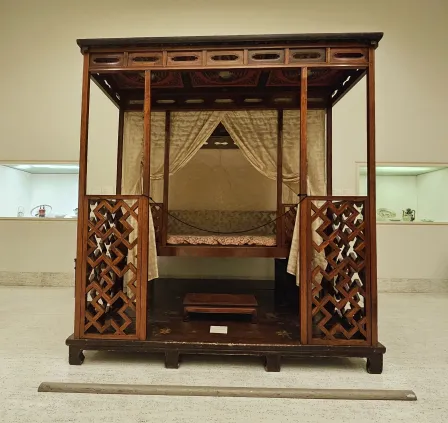
Yes, definitely. There is a signature canopy bed in the gallery. If we read the object tags carefully, it will tell us that it was purchased by the museum in 1964 from Mr. and Mrs. James Speer II. Further research revealed that Mr. Speer had served as a Foreign Service Officer in Beijing during the 1940s before becoming a political science professor in the States. While these facts answered the worksheet questions, they raised more questions: Did Mr. Speer’s political networks in China influence how he came to possess the bed? Why would a museum acquire a Chinese bed as “art”? The second question opens the door to broader reflections: What defines art? What does it mean to classify an object as art when it originates from a cultural and geographical context outside the Eurocentric timeline of art history from antiquity to modernity?
So, object tags are really important in recording history!
They are. Although they appear short, there are so many meta-questions embedded in them. These are questions that invite us to reflect on the legitimacy of a gallery, and the historical and epistemological structures that dictate how objects are institutionally collected, classified, and valued.
In your view, what makes museums valuable as a pedagogical space?
The importance of object tags shows the importance of the museum’s gallery as a learning environment. Directing students’ attention to these labels is not merely about looking for background information for a static exhibit; it’s about inviting students to see the still objects as carriers of movement—displaced from their original cultural contexts and re-situated within modern institutions and catalogues. In this way, the gallery is more than a space for hoarding and displaying items. It becomes a site of critical inquiry, one encouraging the students to engage the museum as a dynamic site of globalization and knowledge production, and to think about the political, social, and economic forces that prompted such activities.